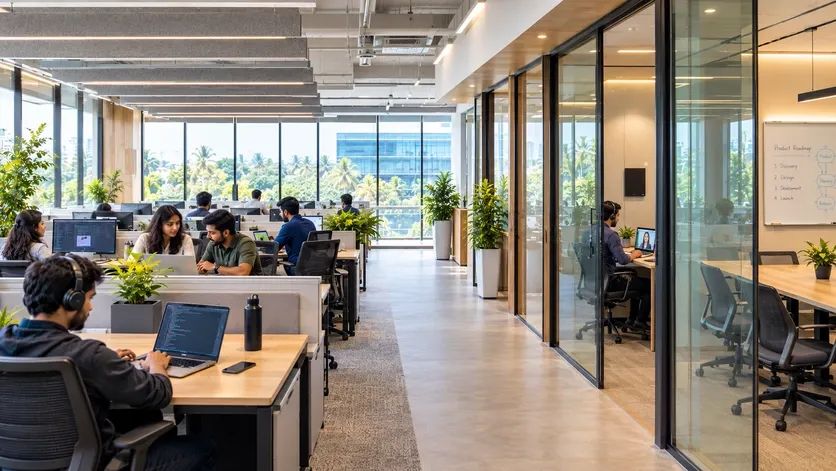
The choice of an office layout is a major decision for a startup. It has to enable people to work together, give them space to focus and allow for growth without unnecessary expense. Open plan offices bring teams together and private offices offer more separation and privacy. Each has its strengths, and the right one depends on the work your people do every day. For entrepreneurs looking at workspace options, Lulu Techpark at SmartCity Kochi is a useful place to think about location, infrastructure and the kind of office a growing business needs. Knowing the differences helps you choose a workspace that suits your team now and your plans for later.
What Is an Open-Plan Office?
An open-plan office is one big shared work space, with little or no full height walls between people. Teams sit at shared desks or in clusters of workstations so it’s easy to chat to a colleague or discuss work without booking a meeting room.
This is a great layout for a startup where people are constantly throwing ideas off each other or reviewing work together and needing quick response. The downside is noise, which builds up when a few people are on calls or working on different things at the same time.
What Is a Private Office Layout?
A private office set-up is made up of rooms enclosed for one person, a department or a small group of people. Walls and doors are useful for keeping out the surrounding activity which is good for confidential conversations, client meetings and tasks that require focus. When exploring office space for rent in Kochi, startups should consider whether a private office setup suits their team's needs.
If your startup deals with sensitive client data or long video calls, you may want private rooms. But closed offices require more space, and can inhibit spontaneous day-to-day collaboration. Think about how much privacy you really need before you start giving individual rooms to large sections of the office.
Pros and Cons of Open-Plan Offices for Startups
An open-plan layout suits startups that rely on regular communication and need to use their space efficiently.
Advantages
Easier collaboration: Team members can talk through problems, share feedback and coordinate tasks quickly.
Space efficiency: Shared workstations fit a growing team without a separate room for each person.
Flexibility: Desks can usually be moved as teams, responsibilities and headcount change.
Limitations
Noise and distractions: Conversations and calls can interrupt people who need to concentrate.
Limited privacy: Sensitive discussions and confidential calls may need a separate room.
Different working preferences: Some employees find a busy, shared environment tiring.
Pros and Cons of Private Offices for Startups
Private offices offer a quieter setting for work that needs privacy or sustained attention. They help most when a startup regularly handles confidential information or holds discussions that should not be overheard.
Advantages
Better privacy: Client calls, interviews and sensitive matters are easier to handle.
Fewer interruptions: Enclosed rooms help people focus on complex tasks.
Professional meeting space: A private room suits client discussions and internal reviews.
Limitations
Higher space requirements: More walls and separate rooms mean fewer workstations in the same area.
Reduced informal interaction: It is less convenient to approach colleagues in other rooms.
Less flexibility: Changing a floor plan with permanent partitions gets harder as the startup grows.
For many small businesses, a completely private-room office is not the best balance. The aim is to provide privacy where it is needed without splitting the team apart.
Open-Plan vs Private Office: Side-by-Side Comparison
This comparison can help founders see which layout fits their current needs.
| Factor | Open-plan office | Private office |
| Team collaboration | Easier informal interaction | Often needs planned discussions |
| Concentration | Can be affected by noise | Greater separation from activity |
| Confidentiality | Limited without separate rooms | Better for private conversations |
| Space use | Generally more efficient | Needs more space per enclosed room |
| Future changes | Desks are easier to rearrange | Structural changes may be costly |
Neither layout is automatically more productive. The best choice depends on the startup’s work patterns, its people and the space available.
Which Office Layout Suits Your Startup Stage?
A startup’s workspace needs tend to change as the business develops.
Early-stage startups: A small open-plan area is practical when founders and a few employees work side by side. Access to a meeting room for calls and discussions stops the lack of privacy from becoming a problem.
Growing teams: As departments and responsibilities become more distinct, a mix of shared desks and enclosed rooms balances collaboration with focused work.
Established startups: Teams with larger client accounts, management duties or confidential operations may need dedicated rooms alongside shared working areas.
Why Hybrid Office Layouts Are Gaining Popularity
The hybrid office layout blends open workstations with private offices, meeting rooms or smaller focus areas. The shared space is for collaboration and people move to quieter rooms for privacy or focused work. Businesses exploring managed office space in Kochi can benefit from this flexible layout.
In a technology startup, for example, developers may need quiet stretches to solve hard problems, while product teams gain from talking through requirements together. Sales staff may need rooms for client calls. A hybrid arrangement covers all of these without giving everyone a private office.
Good planning makes it work. Meeting rooms should be free when needed, walkways must stay clear, and shared areas should not intrude on quieter zones. Acoustic panels, suitable partitions and clear guidelines for calls also help control noise.
5 Questions to Ask Before Choosing an Office Layout
Before you sign a lease or settle an office plan, ask yourself these five questions:
How does the team work? Identify which tasks need collaboration and which need quiet concentration.
How many employees will join? Think about likely growth over the next few years, not just today’s headcount.
How much privacy is necessary? Account for client calls, interviews, confidential information and management discussions.
What is the total budget? Include rent, interiors, furniture, utilities and the cost of changing the layout later.
Can the space adapt? Check whether the office can take more desks, meeting rooms or enclosed areas as needs change.
Your answers will help narrow down the type and size of office that makes sense for the business.
Flexible Office Layouts at Lulu Techpark, SmartCity Kochi
The office environment is only one part of the decision. Startups should also look at connectivity, power reliability, access, parking and the facilities available to employees.
Lulu IT Parks offers high-speed fibre connectivity, 100% power backup, security and parking. These facilities matter for businesses that need dependable infrastructure as they grow.
When you enquire about office space in Kakkanad, ask about available floor areas, layout options, fit-out permissions and whether open workstations can sit alongside private rooms. What is possible depends on the particular unit and lease terms.
Choose Lulu Techpark for the Best Office Space for Startups in Kochi
Choosing an office is not simply a choice between open desks and private cabins. A startup needs space that matches its way of working, budget and can adapt to changes in the future.
Lulu Techpark is a premium office space in Kochi and provides all the required infrastructure for companies seeking office space for startups in Kochi to function seamlessly. Tell us about your needs before you decide whether a collaborative environment or a combination of communal and private spaces is best suited for your team.
Companies searching for quality office space in Kochi can explore the various possibilities and ensure they meet their headcount and operations. When comparing office space in Kochi and the numerous tech parks in Kerala, don’t just look at how they seem. Think about the things your firm actually requires.
Visit Lulu Techpark and enquire about the available office spaces and get one that suits your startup’s needs.

Lulu ITpark
Tech Community WriterHi! I’m a writer for Lulu IT Park, sharing the latest updates, technology trends, and industry insights from our vibrant tech community. I’m passionate about highlighting workspace innovation and the incredible growth within our campus.